
THE HIGH PERFORMANCE LEADERSHIP FRAMEWORK
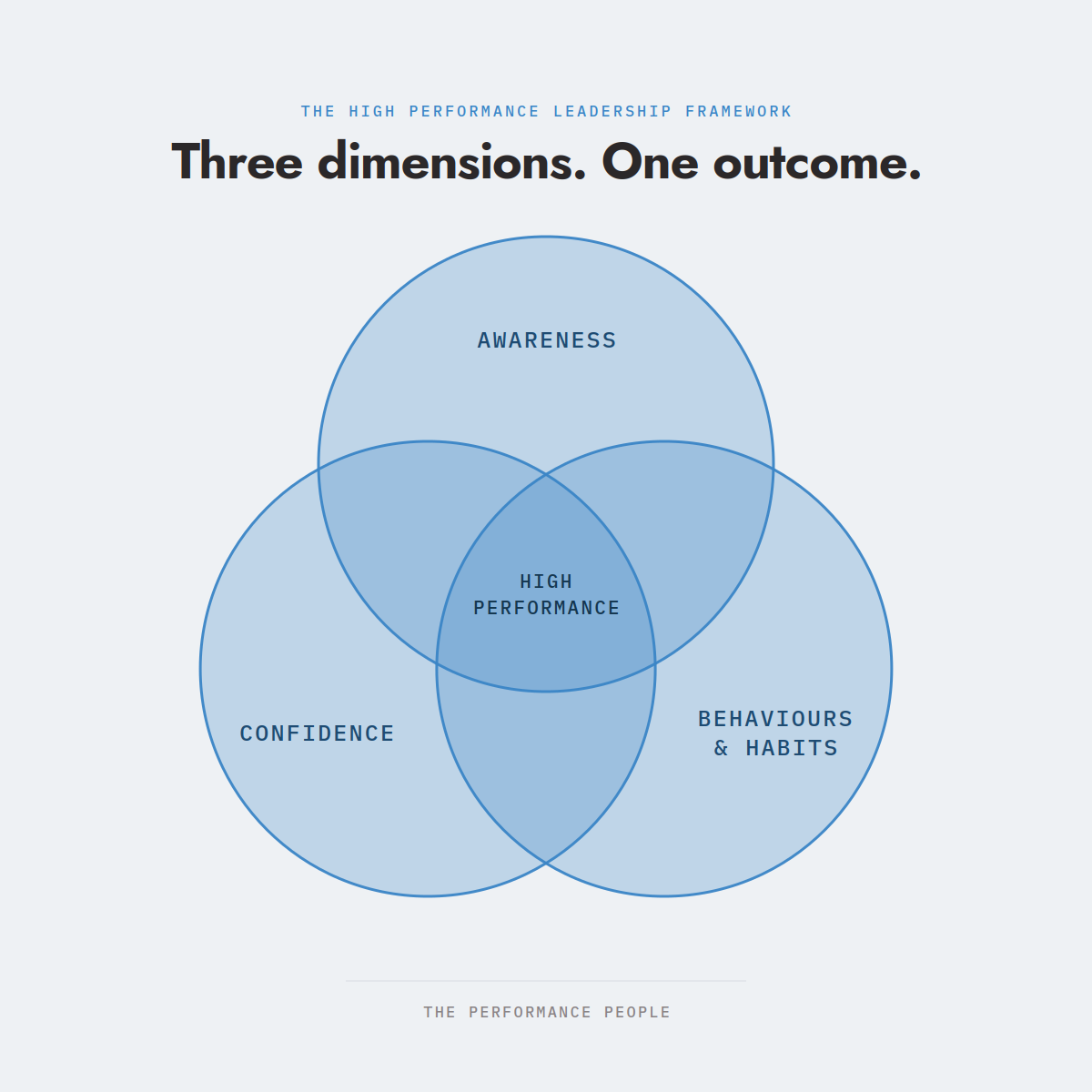
Three dimensions decide whether capability becomes performance.
Most leadership models list ten or twelve competencies. In practice, almost everything that separates a capable leader from a high-performing one sits in three places: how clearly they see themselves, what they repeatedly do, and whether they back their own judgement. This is the framework behind every assessment, coaching engagement and programme we run.
Score yourself in 60 seconds - take the assessment now.
DIMENSION ONE
Awareness
Awareness is how clearly a leader sees their own impact, and how actively they go looking for the parts they cannot see.
What it looks like when it's strong. The leader knows how they land in a room before anyone tells them. They ask for feedback that is likely to be uncomfortable, and they ask people junior enough to give it honestly. They notice when a decision is being driven by mood rather than evidence, and they say so.
What its absence costs. Seniority insulates people from the truth. The more senior the role, the less honest the feedback, and the wider the gap between how a leader believes they land and how they actually land. That gap never closes on its own, because nobody in the organisation is incentivised to close it. Teams quietly adapt around the blind spot instead, and the cost shows up as attrition, slow decisions and problems that arrive late.
How we develop it - assessment, 360 feedback, structured reflection, and coaching.
DIMENSION TWO
Behaviours & Habits
Behaviours and habits are what a leader actually does, repeatedly, under normal conditions and under load.
What it looks like when it's strong. The standards the leader talks about are the standards they visibly hold. Difficult (let’s call them ‘honest’) conversations happen close to the event rather than at the annual review. Time goes to the work only they can do. When pressure arrives, the behaviour stays recognisable.
What its absence costs. Teams read habits, not intentions. A leader who believes in developing people but never delegates anything meaningful has communicated the opposite, regardless of what they say in the town hall. The gap between stated values and observed behaviour is the single fastest way to lose credibility with a senior team, and it is almost always invisible to the person creating it.
How we develop it - 360 feedback, structured reflection, and coaching.
DIMENSION THREE
Confidence
Confidence is a leader's willingness to decide without certainty, to challenge upward, and to hold steady when the ground moves.
What it looks like when it's strong. Decisions get made on incomplete information rather than deferred until the information is complete, which it rarely becomes. The leader says the uncomfortable thing in the room instead of afterwards. When something goes badly wrong, the people around them borrow their composure.
What its absence costs. Sound judgement that never gets voiced doesn't count. The cost here is almost entirely invisible, which is what makes it dangerous: the decision delayed by three weeks, the challenge left unsaid in a board meeting, the risk nobody named. None of it appears in a report. All of it compounds.
How we develop it - structured development experiences and coaching.
WHY THREE
Why three dimensions and not twelve
Behind the framework sits a lot of work to make sure it measures what actually makes the difference. It is based on a blend of academic research, assessment data, leadership behaviours/competencies, leadership theory, and most importantly, many years of experience.
But while detailed competency frameworks are comprehensive, they are often too complicated for the end user. We want our leaders to focus on leading. If they’re handed a list of thirty plus leadership behaviours, it’s likely they’ll all get ignored.
Three dimensions is small enough to hold in your head during an actual working week, and they are sequential and overlapping: awareness makes the habits visible, the habits make the confidence earned rather than performed.
COMMON QUESTIONS
What is a leadership framework?
A leadership framework defines the specific behaviours and capabilities an organisation expects at each level of leadership, so that development, assessment and performance management all measure the same things. Without one, each of those decisions is made against a different, unstated standard. They aim to support objective decision making.
How is this different from a psychometric test?
A psychometric measures traits and preferences, which are relatively fixed. This framework measures behaviours and habits, which are not. As part of our assessment and development offerings we will use psychometrics as part of that process. We will measure specific traits and preferences as well as other areas, this provides a holistic view of your leadership capability and also provides insights into work preferences etc.
How long does it take to see change?
As with anything that involves humans, it’s impossible to put a specific number on it. It also depends on the outcome you’re looking for. If you’re looking to develop an incumbent executive, or executive team, you are likely to see changes within the first few months. If you want to identify and develop a cohort of future leaders, this is likely to be a process over several months or years to ensure fully rounded leaders ready to take on executive level responsibility.